

Ever supported your favorite cricket team, but witnessed their defeat at the hands of a less favored team? This is what cricket is all about. An outstanding batting order doesn’t mean much if the pitch favors bowling and an unforeseen injury can reverse the situation. Expert predictions cannot be made simply by looking at rankings or getting tips from social media.
There are numerous things that one has to consider including the pitch, recent form, playing XI, and match situations among others. Even then, not every prediction guarantees victory. In this article, we are going to discuss how to make expert match predictions in cricket ID online.
In order to make a cricket match prediction, one must study the wicket, assess the form of both teams, study player clashes, and see which players are confirmed in the playing eleven.
The goal isn't to guess the winner with complete certainty. It's to understand which team has an advantage and why.
Here's how to approach each match.
A team can dominate at one stadium and struggle at another. That's why pitch conditions deserve attention before recent win-loss records.
Start by checking whether the surface generally supports fast bowlers, spinners, or batters.
For example, a dry pitch with a history of sharp turn may suit a team with strong spin bowlers. A surface offering seam movement could favour a quality pace attack.
Also, check the venue's recent scoring patterns.
Look at:
However, don't assume every match at a stadium follows the same pattern. Pitch preparation, weather, and the specific strip used can change the game.
Expert tip: Compare recent matches in the same format. A Test match score tells you little about what constitutes a strong T20 total.
A higher-ranked team isn't automatically the stronger choice for a particular match.
Imagine Team A has won eight of its previous ten matches, but most victories came against weaker opponents.
Meanwhile, Team B has won five matches against stronger sides under similar conditions.
Which team is actually in better form?
Rather than looking at win percentages alone, consider the quality of opposition and where those matches took place.
Pay attention to recent batting collapses, bowling performance in the final overs, and the team's ability to handle pressure.
For T20 matches, the last five to ten games can offer useful clues. However, a small sample doesn't tell the entire story.
A team that lost two close matches may be performing better than the results suggest.
Cricket isn't simply eleven players competing against another eleven. Certain individual contests can influence the entire match.
For example, a top-order batter might struggle against left-arm pace. A leading spinner may have an excellent record against a particular middle order.
These details help explain why team averages don't always predict what happens on the field.
Focus on three questions:
Also, consider a player's role.
A batter who scores quickly during the powerplay has a different job from someone who finishes an innings.
Don't compare their statistics without accounting for those roles.
The toss and confirmed playing XI can change your assessment because they reveal the actual team combination and who will bat first.
Before the toss, you're working with expected lineups. After it, you know which players are available and the team's first tactical decision.
Suppose a team leaves out its main fast bowler and adds another spinner.
That change could make sense on a turning pitch. However, it may weaken the attack on a surface that favours pace.
Similarly, replacing an all-rounder with a specialist batter can change the team's balance.
Check the official team announcement rather than relying on an old predicted lineup.
In evening T20 matches, dew can make the ball harder to grip. That may influence bowling plans and the decision to chase.
Rain can also shorten a match and change its scoring pattern.
However, winning the toss doesn't guarantee an advantage. The actual pitch, team strengths, and match situation still matter.
A good habit would be to make one assessment before the toss and review it after the playing XIs are announced.
If the new information changes your view, explain why.
Statistics become useful when you connect them to the match you're analysing.
For example, a batter averaging 45 runs may appear more reliable than someone averaging 32. But those figures mean less without knowing the format, opposition, and sample size.
Use credible scorecards and records from sources such as the ICC and ESPNcricinfo.
Focus on relevant numbers rather than collecting every statistic available.
Don't rely heavily on head-to-head results from several years ago. Teams change, players retire, and conditions differ.
Likewise, avoid judging a player's form from one outstanding innings.
The best statistics answer a specific question. If a number doesn't help explain the current match, it probably doesn't deserve much attention.
The 3-Question Prediction Test: Is Your Analysis Strong Enough?
Here's a practical method that separates a reasoned prediction from a guess.
Before deciding which team you expect to win, answer three questions.
1. What is the strongest reason behind my prediction?
Perhaps one team has a stronger bowling attack for the expected pitch.
Write down that reason clearly. “They're a famous team” doesn't count.
2. What could prove my prediction wrong?
Maybe the opposition has a batter who performs exceptionally well against spin.
Every prediction should have a counterargument. Ignoring opposing evidence makes your analysis weaker.
3. What information would change my opinion?
It could be a surprise team selection, a major weather change, or an unexpected pitch report.
If you can answer all three questions, your analysis has more substance than a simple win-loss guess.
This is where long-term learning happens.
Record your predicted winner, the main reason, the confidence level, and the actual result.
After the match, review whether your reasoning was sound.
Sometimes, a good prediction fails because of an exceptional performance. Other times, a correct prediction happens for completely different reasons.
Learning to recognise that difference matters more than celebrating one lucky result.
A cricket prediction describes a possible outcome. Probability expresses how likely that outcome appears.
For example, estimating that a team has a 60% chance of winning still leaves a 40% chance of another result.
That estimate is not a guarantee.
Betting odds reflect market prices and include a bookmaker's margin. They are not necessarily an unbiased measure of the true probability of an outcome.
Also, no statistical model can account perfectly for sudden injuries, fielding errors, weather changes, or an extraordinary individual performance.
If predictions are connected to paid betting activity, treat financial risk separately from match analysis. Before using any platform such as Lotus365, read its terms and withdrawal rules. Set firm limits, never chase losses, and don’t treat cricket predictions as a source of guaranteed income.
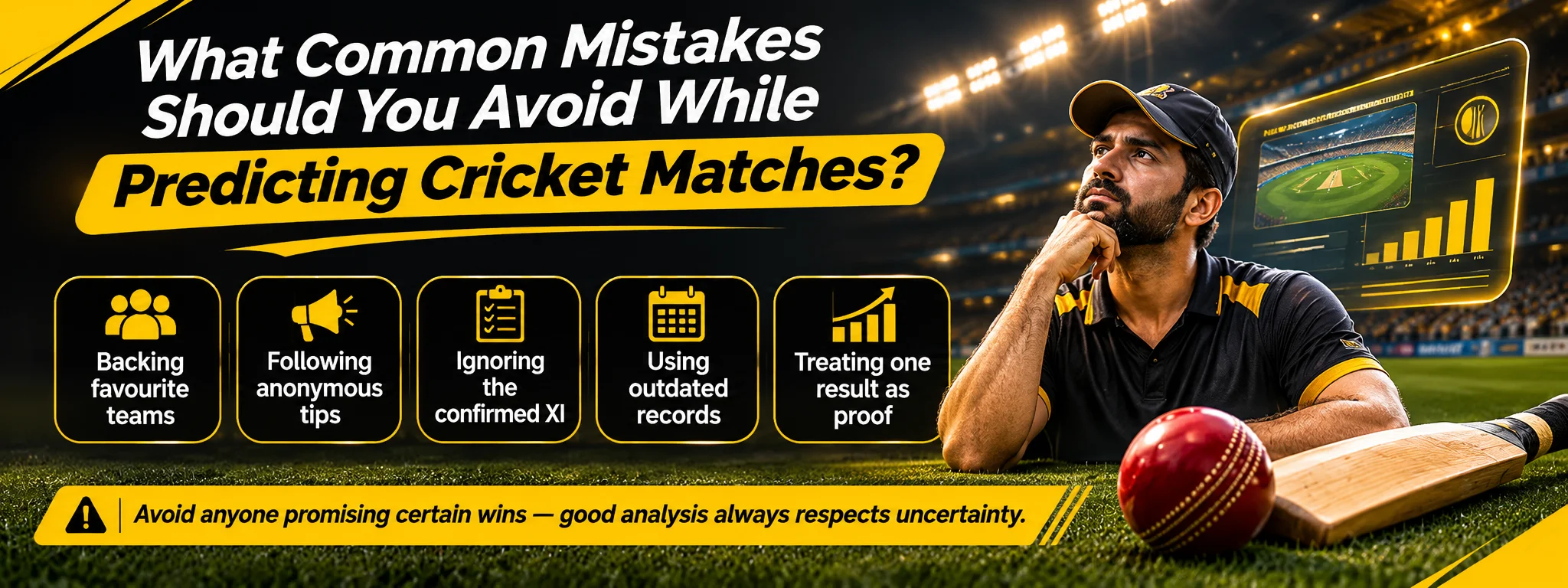
Even experienced fans can make poor predictions when emotions replace evidence.
Watch out for these habits:
Above all, avoid anyone promising certain wins. Cricket is unpredictable, and legitimate analysis should acknowledge uncertainty.
At FreeCricketID, we help users understand online cricket ID access and related platform information. Explore our guidance, check relevant requirements, and contact our team for assistance with account-related questions today.
Expert cricket match predictions start with careful analysis, not confident guesses.
Study the pitch, team form, player matchups, confirmed XI, and weather before forming an opinion.
However, don't stop once the match ends. Review your reasoning to understand what you assessed correctly and what you missed.
A consistent research process can improve your understanding of cricket, even though it cannot guarantee accurate predictions every time.

Rohan Mehta is a seasoned iGaming analyst with over 7 years of experience in the online betting industry. He specializes in user verification systems, betting IDs, and platform security. Rohan provides clear, trustworthy insights to help users navigate the online betting space with confidence.


BeGambleAware.org


Free Cricket ID Platform is for entertainment purposes only. We do not promote or support any form of illegal betting. Users must be 18+ and are responsible for complying with their local laws. Use the ID at your own risk – we are not liable for any profits or losses.


